 |
| On January 3, 1989, The Arsenio Hall Show premiered as the first first late-night talk show with an African American host, and aired late weeknights in syndication until May 27, 1994. |
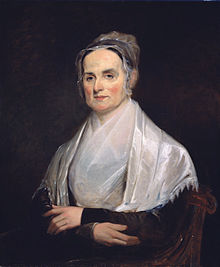
Lucretia Coffin Mott (January 3, 1793 - November 11, 1880) was one of the most notable American women of the nineteenth century for her support of abolition and women's rights. She and her huband, John Mott, were among the founders of the American Anti-Slavery Society, and she was the only woman to speak at the first organizational meeting, She was also a founder of the interracial Philadelphia Female Anti-Slavery Society. In June 1840, she was one of six female delegates attending the General Anti-Slavery Convention, better known as the World's Anti-Slavery Convention, in London, England. The women were not allowed to participate and were seated in a segregated area, where they were joined by William Lloyd Garrison and other male activists. She was also part of the American Free Produce Association, which boycotted products made by slave labor.
Birthdays
Sophia B. Packard (January 3, 1824 - June 21, 1891) and her partner Harriet Giles founded what was to become Spelman College as the Atlanta Baptist Female Seminary on April 11, 1881. Originally funded by the Women's American Baptist Home Mission Society and housed in the basement of Friendship Baptist Church, John D. Rockefeller donated $5000 to pay the mortgage on a permanent location and the name was named to Spelman in honor of his wife's family.

Mary Magdalena Lewis Tate ("Mother Tate") (January 3, 1871 – December 28, 1930) was the first American woman to serve as a Bishop in a nationally recognized denomination. She founded a Pentecostal denomination, The Church of the Living God, the Pillar and Ground of the Truth, in 1903. Its first convocation was held in June 1903 in Greenville, Alabama. The church was the first Pentecostal Holiness church in America founded by a woman, and spread to at least twenty states. At least seven denominations currently trace their history back to her church.

Marpessa Dawn (January 3, 1934 – August 25, 2008), also known as Gypsy Marpessa Dawn Menor, was an American-born French actress, singer, and dancer, best remembered for her role as Eurydice in the film Black Orpheus (1959). The film won the Palme d'Or at the 1959 Cannes Film Festival and the 1960 Academy Award for Best Foreign Language Film. She appeared in a 2005 documentary about Vinicius de Moraes, who wrote the original play from which Black Orpheus was adapted.
William "Willy" Theodore Ribbs, Jr. (born January 3, 1955) is a retired American race car driver, racing owner, and sport shooter known for being the first African-American man to have tested a Formula One car in 1986 and the first to compete in the Indianapolis 500 in 1991. Ribbs competed in many forms of auto racing, including the Trans-Am Series, IndyCar, Champ Car, IMSA, and the NASCAR Sprint Cup Series and Craftsman Truck Series.
Events
On January 3, 1966, Sammy Younge Jr. was shot to death during an altercation over using a whites-only restroom by Tuskegee gas station attendant Marvin Segrest. An all-white jury, in an overwhelmingly black county, deliberated for an hour and ten minutes before finding Segrest not guilty. Younge was a Tuskegee student and active in the Tuskegee Institute for Advancement League (TIAL), which was affililated with SNCC, and worked to integrate public businesses in Tuskegee and for voting rights throughout the south.
On January 3, 1989,
The Arsenio Hall Show premiered as the first first late-night talk show with an African American host, and aired late weeknights in syndication until May 27, 1994. The show was created and hosted by Hall, who had previously been the announcer for Alan Thicke;s talk show,
Thicke of the Night.
Photo Gallery
 |
| USNR Chief Quartermaster L. J. Russell teaching navigation to African-American sailors Charles W. Divers, Royal H. Gooden, Lewis F. Blanton, and Calvin Bell, Norfolk VA, 3 January 1944 (US National Archives) |
 |
| Navy USS Mason (DE-529), 1944-1947 Signalman 1st Class Ernest V. Alderman, USNR, (right) explains various parts of a signal lamp to SM2c Julius Holmes, during training for Mason's crew at Norfolk Naval Training Station, Virginia, 3 January 1944. Official U.S. Navy Photograph, National Archives. |
 |
| Reverend C. K. Steele at the Bethel Missionary Baptist Church, Tallahassee, January 3, 1957. Segregationists smashed windows at Reverend Steele’s house and burned crosses on numerous occasions in an attempt to intimidate the African-American community during the Tallahassee Bus Boycott. |
 |
| Leontyne Price, Metropolitan Opera Farewell Performance, January 3, 1985 |
 |
| On January 3, 1987, Aretha Franklin became the first woman inducted into the Rock and Roll Hall of Fame. |
Publications
 |
| "MAY MAKE NEGROES WHITE. Chicagoan Believes It Possible to Neutralize the Color Units." The New York Times, January 3, 1910 |
 |
| Jet Magazine - January 3, 1952 |
 |
| Actor William Marshall, Later Known as Count Blacula - Jet Magazine January 3, 1952 |
 |
| Do Negroes Die Poor? - Jet Magazine, January 3, 1957 |
 |
| Pearl Bailey and her husband Louis Bellson play with their son Tony in this photograph for Jet Magazine's January 3, 1957 issue. |
 |
| Unforgivable Blackness: The Rise and Fall of Jack Johnson by Geoffrey C. Ward. $14.98. Author: Geoffrey C. Ward. Publisher: Vintage (January 3, 2006). |
.


