Showing posts with label Diahann Carroll. Show all posts

December 26


Jean Toomer (born Nathan Pinchback Toomer, December 26, 1894 - March 30, 1967) was best known for his 1923 novel Cane, and its reprint soon after his death led to an increased interest in his poetry, essays, and other writings. The setting for the novel is based on his experience in 1921 as principal of Sparta Agricultural and Industrial Institute in Sparta, Georgia, although he was primarily raised in mostly- white neighborhoods in Washington D.C. and New York by his maternal grandfather, P. B. S. Pinchback, the first African American governor in the United States. His estranged father's family lived in the Sparta area and many appear as thinly-disguised characters in the novel.  Toomer was published in literary and socialist political journals during the Harlem Renaissance. His writing took on more of a spiritual nature as he studied under Russian mystic George Gurdjieff and read the works of Carl Jung. He became a Quaker in 1940, and wrote little more for publication.

Birthdays

Bazoline Estelle Usher (December 26, 1885 - February 8, 1992) graduated from Atlanta University and had a 40-year career in the Atlanta public school system as a teacher, principal, and Supervisor of Education for Minority Pupils. She also led a group of about 25 women who created the first African American Girl Scout troops in Atlanta.

Una Mae Carlisle (December 26, 1915 - November 7, 1956) played piano at the age of three and was performing publicly by the time she was 10. She was discovered at 16 by Fats Waller while she worked as a local Cincinnati performer live and on radio. Her piano style was much influenced by Waller's; she played in a boogie-woogie/stride style and incorporated humor into her sets. She played solo from 1937, touring Europe repeatedly and recording with Waller late in the 1930s. In the 1940s Carlisle recorded as a leader for Bluebird Records, with sidemen such as Lester Young, Benny Carter, and John Kirby.

Lonne Elder III (December 26, 1927 - June 11, 1996) first received acclaim for his play, Ceremonies in Dark Old Men, produced in 1969 by the Negro Ensemble Company. It won him a Drama Desk Award for Most Promising Playwright and was nominated for the Pulitzer Prize. Subsequent productions of the play nurtured the stage careers of several prominent actors, including Denzel Washington, Billy Dee Williams, Keith David, and Laurence Fishburne. Elder also wrote the screenplay for the film Sounder, based on the novel by William H. Armstrong. The film was nominated for four academy awards including Best Adapted Screenplay. Elder was the first African American male to receive this honor and went on to write the sequel.

Harold Cash (born December 26, 1948) retired from bull and bronco riding in 1995 and currently serves as president of The Over The Hill and Future Cowboys Rodeo Association, which puts on two rodeos a year with proceeds used to place new head stones on cowboys' graves. He also sponsors the annual Harold Cash Spring Rodeo Roundup, held at the Galveston County Fairgrounds in Hitchcock. Proceeds from the rodeo go to scholarships for underprivileged children. Cash holds a degree in Industrial Technology from Prairie View A&M and in 1982 he and Myrtis Dightman opened the first black country-western club in Houston.

Osborne Earl "Ozzie" Smith (born December 26, 1954) is a former shortstop who played for the San Diego Padres and St. Louis Cardinals from 1978 to 1996. Nicknamed "The Wizard" for his defensive brilliance, Smith set major league records for career assists (8,375) and double plays (1,590) by a shortstop (the latter since broken by Omar Vizquel), as well as the National League (NL) record with 2,511 career games at the position; Smith won the NL Gold Glove Award for play at shortstop for 13 consecutive seasons (1980–92). He was elected to the Baseball Hall of Fame in his first year of eligibility in 2002.

Events

On December 26, 1908 Jack Johnson became the first African American to win the world heavyweight boxing title. Johnson knocked out Canadian Tommy Burns in the 14th round in a championship fight near Sydney, Australia. Whites hated Johnson, who held the heavyweight title until 1915, for his defiance of the "Jim Crow" racial segregation and oppression of early 20th-century America.

On December 26, 1944, First Lieutenant John Robert Fox of the 366th Infantry Regiment was killed in action when he deliberately called for artillery fire on his own position, after his position was overrun, in order to defeat a German attack in the vicinity of Sommocolonia, northern Italy during World War II. Fox's sacrifice gained time for the U.S. forces to organize a counterattack and retake the village. When they did so, they found Fox’s body as well as about one hundred dead German soldiers. He posthumously received the Medal of Honor in 1997 after it was determined that African American soldiers had been denied consideration for the Medal of Honor because of their race.

On December 26, 1966 Kwanzaa was first celebrated by Ron Karenga. His goal was to "give Blacks an alternative to the existing holiday and give Blacks an opportunity to celebrate themselves and their history, rather than simply imitate the practice of the dominant society." It is a 7-day celebration inspired by African "first fruit" traditions, and the name is derived from the name for the Swahili first fruit celebration, “matunda ya kwanza.” The principle represented by the first day is Umoja (unity).


Publications

Myra Rigaud, A Xavier University Graduate, Covers Jet - Jet Magazine December 26, 1963

James Brown, Jet Magazine, December 26, 1968

Diahann Carroll and Fred Williamson on the cover of the Dec. 26-Jan 1, 1971 issue of TV Guide.

Jet Magazine, December 26, 1974: Esther Rolle

Words with Wings: A Treasury of African-American Poetry and Art by Belinda Rochelle. $14.24. 48 pages. Publisher: Amistad (December 26, 2000).  

From Private to General: An African American Soldier Rises Through the Ranks by Jerry Curry. $13.49. Publisher: Believe Books (December 26, 2006).

.

December 24


On December 24, 1968, NBC's Julia aired the episode "I'm Dreaming of a Black Christmas". On the same day, the photo on the left was taken at Herbert Hoover Boys' Club in St. Louis.

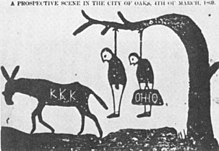
On December 24, 1865, six Confederate veterans met in Pulaski, Tennessee to form the Ku Klux Klan as a means to counter the post-Civil War changes in Southern society through threats and violence toward Northerners, recently emancipated slaves, and their sympathizers. Although former Confederate Brigadier General George Gordon codified the beliefs and structure of the Klan, and General Nathan Bedford Forrest served as its first Grand Wizard (national leader), there was no organized hierarchy and local groups acted independently of each other.

The extreme violence surrounding the 1868 Presidential election of Ulysses S. Grant with thousands of African Americans killed led some leaders to distance themselves from the Klan and to urge that attacks be curtailed in order to avoid government intervention. In 1870 a Federal grand jury determined that the Klan was a terrorist organization, and the following year Congressman Benjamin Franklin Butler of Massachusetts introduced the Civil Rights Act of 1871 (Ku Klux Klan Act), which allowed President Grant to use military force to stop any Klan activity, with participants being tried in Federal court.

Local vigilante groups continued to use violence to maintain white supremacy, and in 1915 the Klan was reborn as a highly structured national movement centered in the midwest, and claiming to operate as a Christian fraternal organization. Although it peaked with a reported membership of six million, it declined by the end of the 1920s due to financial mismanagement and murder charges against Grand Dragon D.C. Stephenson. A third wave of the Klan surfaced during the 1950s as a reaction to the Civil Rights Movement as a loosely joined group of local white supremacists.

Birthdays

Octavia V. Rogers Albert (December 24, 1853 – August 18, 1889) taught in Montezuma, Georgia, where she met and later married fellow teacher,
Methodist Episcopal pastor Dr. Aristide Elphonso Peter (A. E. P.) Albert. The couple lived in Houma, Louisiana, where she interviewed formerly enslaved men and women over a period of fifteen years, collecting their stories in The House of Bondage, or Charlotte Brooks and Other Slaves which was first published in installments after her death in the New Orleans-based Methodist Episcopal Church newspaper, the “Southwestern Christian Advocate”.  

Warren "Baby" Dodds (December 24, 1898 – February 14, 1959) was a jazz drummer born in New Orleans, Louisiana. He is regarded as one of the best jazz drummers of the pre-big band era, and one of the most important early jazz drummers. He varied his drum patterns with accents and flourishes, and he generally kept the beat with the bass drum while playing buzz rolls on the snare. Some of his early influences included Louis Cottrell, Sr., Harry Zeno, Henry Martin, and Tubby Hall. Dodds was among the first drummers to be recorded who improvised while performing.

Irvin Charles Mollison (December 24, 1898 - May 5, 1962) was the first African American appointed to a position in the federal judiciary whose position was posthumously converted into an Article III judgeship. Judge Mollison also was the first African American to serve on the United States Customs Court. He was appointed by President Truman, and confirmed by the United States Senate without a single dissenting vote. He was a 1923 graduate of the University of Chicago Law School. 

Jabbo Smith (born Cladys Smith, December 24, 1908 – January 16, 1991) was raised in the  the Jenkins Orphanage in Charleston, South Carolina where he learned trumpet and trombone, and by age ten was touring with the Jenkins Band. At age 16 he left the orphanage to become a professional musician, at first playing in bands in Philadelphia and Atlantic City before making his base in New York City from about 1925 through 1928. In the 1930s, he moved to Milwaukee where he collaborated with saxophonist Bill Johnson. Subsequently, Smith dropped out of the public eye, playing music part-time in Milwaukee with a regular job at an automobile hire company. 

Stormé DeLarverie (December 24, 1920-May 24, 2014) who was born in New Orleans to a white father and black mother, was a lesbian whose scuffle with the police was one of the defining moments of the Stonewall riots, spurring the crowd to action. Some have referred to her as "the gay community’s Rosa Parks". During the 1950s and '60s she toured the black theater circuit as the only drag king of the Jewel Box Revue, America’s first racially integrated female impersonation show.

Lloyd W. "Fig" Newton (born December 24, 1942) is a retired United States Air Force four-star general who served as Commander, Air Education and Training Command (COMAETC) from 1997 to 2000. He was also the first African-American pilot in the U.S. Air Force Thunderbirds. He earned a bachelor of science degree in aviation education from Tennessee State University in Nashville, where he was commissioned as a distinguished graduate through the Air Force Reserve Officer Training Corps program in 1966.  He flew 269 combat missions from Da Nang Air Base, South Vietnam, including 79 missions over North Vietnam and was selected to join the U.S. Air Force Aerial Demonstration Squadron, the Thunderbirds, in November 1974.

Events

On December 24, 1832 the Georgia Infirmary became the first hospital for African Americans when it was chartered “for the relief and protection of aged and afflicted Africans.” It was established by the Georgia General Assembly and funded by a $ 10,000 grant from the estate of Thomas F. Williams, a local merchant and minister. Today the institution is known as the Adult Day Center-Georgia Infirmary and is part of St. Joseph’s/Candler healthcare network. 

On December 24, 1963, the 28th Regiment, United States Colored Troops began accepting enlistments. Its initial training took place at Camp Fremont located near the south side neighborhood of Fountain Square in Indianapolis, Indiana. Reverend Willis Revels and Garland H. White, both ministers of the African Methodist Episcopal Church in Indianapolis were the chief recruiting officers, and the regiment's commanding officer was Captain Charles S. Russell. After the Confederate surrender at Appomattox, the 28th was moved to the Mexican border in Texas as part of the American response to the French intervention in Mexico.

On December 24, 1878, the Boston Police Department hired its first African American patrolman, Horatio J. Homer. He was later promoted to sergeant in 1895 and retired on January 29, 1919, after 40 years of service. He primarily served in the commissioner's office and guarding visiting dignitaries. Sgt. Homer had previously worked as a waiter, Pullman porter, and janitor of the Globe Theater.


Photo Gallery

Medgar Evers and Myrlie Beasley married on December 24, 1951 and had three children together.

Merry Christmas from The Supremes -- December 24, 1965 -- The Shamrock Hilton Houston, TX

Henry Orlando and Donald Washington with Santa at the Herbert Hoover Boys' Club Christmas party, 24 December 1968. ©Missouri History Museum

On the December 24, 1968 episode of Julia (NBC), titled "I'm Dreaming of a Black Christmas", Julia's (Diahann Carroll) son, Corey (Marc Copage), wants to know if Santa is black or white.

December 24, 2012 | Michelle Obama

Publications

Jet Magazine, December 24, 1953

.

December 14


John Mercer Langston (December 14, 1829 - November 15, 1897) was the son of a white farmer and a freed mixed-race mother who was sent to Ohio along with his brothers to study at Oberlin College. He graduated with a bachelor's degree in 1849 and a Master of Theology in 1852. Unable to be admitted to law school, he read law under a local judge and was admitted to the Ohio State Bar in 1854. The following year he may have become the first African American to be elected to a local position of leadership when he was chosen as town clerk of Bethlehem Township, Ohio.

Along with his brother Charles he founded the Ohio Anti-Slavery Society in 1858 and served as its first president, as well as assisting with the Underground Railroad. During the Civil War he recruited troops for the Union Army, both for the Massachusetts 54th Regiment and for an Ohio regiment. He was founding president of the National Equal Rights League and an inspector general for the Freedmen's Bureau.

After the war he was founding dean of Howard Law School, later serving as vice-president and acting president. While in Washington D.C. he worked with legislators in support of reconstruction, helping Sen. Charles Sumner to draft what would become the Civil Rights Act of 1875. He was appointed Minister to Haiti in 1877, returning to the U.S. five years later to serve as president of the newly-formed Virginia Normal and Collegiate Institute (now Virginia State University).

In 1888 Langston ran for the U.S, House of Representatives and was seated 18 months after a bitterly contested election. He was defeated in his 1990 bid for re-election, and no other African Americans served in Congress from the south until 1972. He was the great-uncle of poet Langston Hughes, who was the grandson of his brother Charles..

Birthdays

Lillian Randolph (December 14, 1898 – September 12, 1980) is best known as the maid Birdie Lee Coggins from The Great Gildersleeve radio comedy and subsequent films, and as Madame Queen on the Amos 'n' Andy radio show and television show from 1937 to 1953. Her best known film roles were those of Annie in It's a Wonderful Life and Bessie in The Bachelor and the Bobby-Soxer. Like her sister, Amanda, Lillian was also one of the actresses to play the part of Beulah on radio. Lillian assumed the role in 1952 when Hattie McDaniel became ill; that same year, she received an "Angel" award from the Caballeros, an African-American businessmen's association, for her work in radio and television for 1951. She played Beulah until 1953, when Amanda took over for her.

Deford Bailey (December 14, 1899 - July 2, 1982) was the first African American to perform at the Grand Ole Opry and one of the first African American stars of country music. He was a pioneer member of the WSM Grand Ole Opry and one of its most popular performers, appearing on the program from 1927 to 1941. During this period he toured with major country stars, including Uncle Dave Macon, Bill Monroe, and Roy Acuff.

Clark Terry (born December 14, 1920)was an American swing and bebop trumpeter, a pioneer of the flugelhorn in jazz, composer, educator, and NEA Jazz Masters inductee. He played with Charlie Barnet (1947), Count Basie (1948–51), Duke Ellington (1951–59),[3] Quincy Jones (1960), and Oscar Peterson (1964-96). He was also with The Tonight Show Band from 1962 to 1972. Terry's career in jazz spanned more than 70 years, during which he became one of the most recorded jazz musicians ever, appearing on over 900 recordings. Terry also mentored many musicians including Quincy Jones, Miles Davis, Herbie Hancock, and Wynton Marsalis

Ernest (Ernie) Davis (December 14, 1939 – May 18, 1963) played college football for Syracuse University and was the first African American to win the Heisman Trophy (1961). He was the number-one pick in the 1962 NFL draft by the Washington Redskins but was immediately traded to the Cleveland Browns, Davis was diagnosed with leukemia prior to the 1962 American Football Coaches All-American Game and died at the age of 23 before being able to play in the NFL.  He was also the first African American member of the nationwide Jewish fraternity Sigma Alpha Mu.


Events

Ignatius Sancho (c. 1729 – 14 December 1780) was a composer, actor, and writer. He is the first known Black Briton to vote in a British election. He gained fame in his time as "the extraordinary Negro", and to 18th century British abolitionists he became a symbol of the humanity of Africans and immorality of the slave trade. The Letters of the Late Ignatius Sancho, an African, edited and published two years after his death, is one of the earliest accounts of African slavery written in English by a former slave of Spanish and English families.

December 14, 1960, four white and two African American college students (including Randolph-Macon Woman’s College students) entered a Lynchburg drugstore hoping to convince the owner to let them have coffee together. The result was the city’s first sit-in. This landed the college students in jail, prompted additional sit-ins from classmates.

On December 14, 1964 the U.S. Supreme Court ruled in Heart of Atlanta Motel v U.S. that the U.S. Congress could use the power granted to it by the Constitution's Commerce Clause to force private businesses to abide by the Civil Rights Act of 1964. Because the motel drew most of its business from interstate travelers the Supreme Court ruled that it must abide by the roles of interstate commerce.

Photo Gallery

Sammy Davis Jr. was awarded the Spingarn Medal for his "superb and many-faceted talent," along with his contributions to the civil rights movement (December 14, 1968).

The Jackson 5 performed for the first time on The Ed Sullivan Show on December 14, 1969 (CBS)

Johnny Rodgers December 14, 1972 Johnny Rodgers, a running back with the University of Nebraska, is awarded the Heisman Trophy. Rodgers gained a total of 5,586 yards for the Cornhuskers in three years.

December 14, 1991 Desmond Howard, of the University of Michigan wins the Heisman trophy

Denzel Washington (L), star of the film The Hurricane, based on the true story of Rubin Hurricane Carter (C), an innocent man who fought for 20 years for justice, poses at the films premiere party December 14, 1999 in Los Angeles with boxing champion Evander Holyfield. Washington portrays Carter in the film.
D
December 14, 2013: As family members watch, Nelson Mandela's flag-draped coffin arrives at the Mthatha airport for the December 15th funeral and burial in his childhood village Qunu in South Africa.

Publications

TV Guide: December 14, 1968 - Diahann Carroll of "Julia"

.