Horace Mann Bond (November 8, 1904 - December 21, 1972) graduated with honors from Lincoln University in Pennsylvania at age 19. He also held MA and PhD degrees from the University of Chicago, where his dissertation on black education in Alabama won the Rosenberger Prize in 1936. He taught at Langston, Fisk, and Dillard Universities before being named president of Fort Valley State College in Georgia. He was the first African American president of Lincoln University (1945-1957) and finished his career as dean of the Atlanta University School of Education. As early as 1924, Dr. Bond began writing rebuttals to findings that African Americans were intellectually inferior to whites, noting that IQ scores for white southerners were equally low in comparison to national averages, and he collaborated with historians John Hope Franklin and C. Vann Woodward on research for the NAACP's landmark U.S. Supreme Court case in Brown v. Board of Education (1954). After a group of white southern congressmen signed the Southern Manifesto in opposition to school integration, he wrote a widely-read parody of his 1924 article questioning the intellect of the southern politicians and their constituents. Dr. Bond was the father of Congressman and NAACP Chairman Julian Bond.
Birthdays
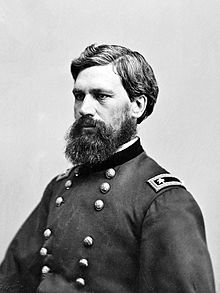
Gen. Oliver Otis Howard (November 8, 1830 – October 26, 1909) was head of the Freedmen's Bureau from 1865 to 1874, devising programs and guidelines including social welfare in the form of rations, schooling, courts, and medical care. The Bureau was also instrumental in gaining the vote for African Americans during this time. Howard was a strong proponent of education, becoming the founding president and namesake of Howard University in 1869. During the Civil War he served as a major general comnanding the the XI Corps, which fought at Antietam, Chancellorsville, and Gettysburg. He was wounded at Seven Pines, losing his right arm.

Maria Louisa Bustill Robeson (November 8,1853 - January 20, 1904) was from a prominent Quaker family in Philadelphia where her great-grandfather, Cyrus Bustill, was a wealthy businessman and a founder of the Free Africa Society. She attended Lincoln University where she met and married William Drew Robeson. Her family disapproved of the marriage because Robeson had escaped from slavery in North Carolina and was very dark-skinned. Their youngest son, Paul, was born only six years before Mrs. Robeson died as the result of a kitchen fire. Her sister Gertrude also married a Lincoln graduate, Nathan Francis Mossell, who became a Philadalephia physician and was the brother of attorney Aaron Mossell.

Eartha White (November 8, 1876 - January 18, 1974) was a Jacksonville, businesswoman and real estate broker who used most of her substantial income to create organizations serving the African American community in the area. She founded the first public school in Bayard for African American children and taught there sixteen years, as well as at her her alma mater, the Stanton School. She and her mother started the Clara White Mission providing meals and shelter to the homeless, which as one time was the largest employer of African Americans in Jacksonville. They also founded the "Colored Old Folks Home", which became the "Eartha White Nursing Home", and is now called "Eartha M. M. White Health Care, Inc.", a 125-bed, $780,000 facility, begun when Eartha was 89. Her other endeavors included establishing Mercy (tuberculosis) Hospital, the Boy's Improvement Club (to reduce delinquency), establishing Oakland Park (the first public park in Jacksonville for African Americans), a halfway house for alcoholics in recovery, a program for released prisoners to help re-enter society, a comprehensive maternity program with a home for unwed mothers, an orphanage and an adoption agency, and a child care center. She never married, saying "I was too busy -- and what man would put up with me?"

Esther Rolle (November 8, 1920 - November 17, 1998) was best known as Florida Evans on the TV sitcom
Good Times (1974-79), a character originally introduced on another Norman Lear show,
Maude. She insisted that the character be married, later saying, "I told them (the producers) I couldn't compound the lie that Black fathers don`t care about their children. I was proud of the family life I was able to introduce to television." She was a founding member of the Negro Ensemble Company and appeared in the 1973 Melvin Van Peebles play,
Don't Play Us Cheap and as Lady Macbeth in Orson Welles' Haitian-influenced version of
Macbeth. She was in a number of made-for-TV movies and won the first Emmy Award for Outstanding Supporting Actress in a Limited Series or a Special in 1979 for
Summer of My German Soldier.
Minnie Riperton (November 8, 1947 – July 12, 1979) sang backup for Chess Records stars such as Etta James, Fontella Bass, Ramsey Lewis, Bo Diddley, Chuck Berry, and Muddy Waters before her 1975 hit
Lovin' You. The next year she was one of the first celebrities to go public with a breast cancer diagnosis and in 1978 received the American Cancer Society's Courage Award which was presented to her at the White House by President Jimmy Carter. She is shown here with daughter Maya Rudolph, who created this tribute to her mother's original cover art on the
Perfect Angel album.
Alfre Woodard (born November 8, 1952) began her acting career in theater. After her breakthrough role in the Off-Broadway play
For Colored Girls Who Have Considered Suicide When the Rainbow Is Enuf (1977), she made her film debut in
Remember My Name (1978). She has appeared extensively on television beginning with an Emmy-winning guest appearance in the premiere of
L.A. Law (1983) and ina recurring role on
St. Elsewhere (1986) opposite Denzel Washington. To date she has been nominated once for an Academy Award and Grammy Award, 18 times for an Emmy Award (winning four), and has also won a Golden Globe Award and three Screen Actors Guild Awards. She is a founder of Artists for a New South Africa, a nonprofit organization dedicated to combating the African AIDS pandemic and advancing democracy and equality in South Africa.
Events
On November 8, 1966, Edward Brooke was elected from Massachusetts as the first African American Senator since Reconstruction, and the first elected by popular vote. He served two terms and had previously been the state's Attorney General. Upon the death of Harry F. Byrd Jr. on July 30, 2013, he became the oldest living former Senator, and remained so until his death on January 3, 2015.
Photo Gallery
 |
| Miles Davis in the recording studios of Fontana Records. Photographed by Hulton Deutsch on 8 November 1963. |
 |
| Martin Luther King, Jr. and his son Marty November 8, 1964 Atlanta, Georgia Photo by Flip Schulke/Corbis |
Publications
 |
| Slaves being driven to Lower South from Virginia, 1862. Harper's Weekly (November 8, 1862), p.713. |
 |
| Will Katherine Dunham Win Aly Khan From Rita? - Jet Magazine, November 8, 1951 |
 |
| Eddie Anderson "Rochester" of the Jack Benny Show - Jet Magazine, November 8, 1951 |
 |
| Black US Air Force Artillerymen with Their “Adopted” Korean Orphans - Jet Magazine, November 8, 1951 |
 |
Dr. Ralph Bunche and Eleanor Roosevelt Observe The First True Colored Doll
Jet Magazine, November 8, 1951 |
 |
Black Panther, November 8, 1969 Offset lithograph 20 1/3 x 14 in (51.5 x 35.6 cm) Collection Alden
and Mary Kimbrough © 2009 Emory Douglas / Artists Rights Society (ARS), New York |
.